A FATHER'S LOVE

Author’s Note

When someone we love passes away, their belongings hold the essence of who they were—like their favorite jewelry or sweater. These items are not just objects; they are filled with memories, traits, and special moments that make them unique.

These cherished items become treasure chests, brimming with love and lessons, embodying the profound impact our loved ones had on our lives. For those left behind, discovering these memories is a comforting reminder that they are still with us.

"A Father’s Love" is a fictional story that reflects the memories I have of my father and the toolbox he gifted me as I set out to leave home and begin my college journey. I carted that toolbox wherever I moved to, and wherever I settled into—the tools were a godsend. It wasn’t until later in life that I finally realized my dad didn’t just gift me a container of tools to help me around the house—he gifted me with the “life tools” I would need to be independent and survive.

This story about Orie and her dad may remind you of your own treasured keepsakes, the simple things that hold so much love.

We can’t keep everything, but hold onto one when you can. In the end, it’s never just about the objects we hold onto — it’s the love, lessons, and memories they quietly carry.
©2025 Myrna Urmanita. All Rights Reserved.

A Father’s Love

A Father's Gift that Lasted a Lifetime

“Give me the Stanley flathead, Orie,” her dad called out, reaching for the screwdriver.

So how many 7-year-old little girls do you know who could tell you the difference between a Flathead and a Phillips screwdriver?

That’s the kind of girl Oriana was. Orie was a nickname her dad gave her. She enjoyed working with tools, even while loving her dolls. Skirts and dresses never appealed to her; she was much more comfortable in pants.

As one of three children—two boys and one girl—Orie was the only daughter, the youngest child, and the baby. Despite having two brothers, she shadowed her father, captivated by everything he did around the house. Whenever he was busy building something in the backyard or garage, Orie was there, eager to lend a hand.

She would spring out of bed on Saturday mornings, racing to find him.

“Hi, Dad, what are you building?” she’d ask, eyes wide with excitement.

“I’m building a barbecue pit. Want to help?” he’d reply.

“What can I do?” she squeaked, jumping up and down, her heart fluttering with joy.

And that was how Orie spent her weekends growing up—her dad, the handyman, and she, his enthusiastic assistant.

Today, at 55, Oriana still has her toolbox. It’s a mismatched collection gathered over the years, but her very first real toolbox was a gift from her dad.

When Orie left for college, he handed her a brand-new toolbox filled with tools, alongside a Samsonite luggage set from her mom—a nod to her new journey. The toolbox was a practical gift, but also a promise: that she could fix anything that came her way.

At seven, Orie wasn’t thinking about symbolism. She was just being herself—doing what she enjoyed, hanging out with her dad. But as the years passed, that toolbox came to represent more than a collection of tools. It was a vessel of love from a man who often kept his emotions inside.

Years later, she was heartbroken when the toolbox was stolen as she moved into a new apartment. It had been a lifeline during her college years, helping her tackle everything from hanging pictures to assembling art projects.

But she didn’t give up on it. She began to rebuild the collection, piece by piece. Every visit home meant asking her dad for an extra screwdriver or a hammer, which he gladly shared—sometimes slipping in a pair of pliers.

When he passed away, Orie and her older brother sorted through his tools in the garage. She claimed the ones her brother didn’t want, grateful to carry forward what their dad no longer needed.

Opening his toolbox, she was hit with a familiar scent that whisked her back to those days in the garage by his side. Even now, whenever she opens her own toolbox, that scent still lingers—a bittersweet reminder of their time together.

Her dad’s tools transported her back to those carefree days: building the barbecue pit, helping in the garden, and learning without realizing she was learning.

As a child, it had all felt like fun.
“This is fun! Shoveling sand is like being at the beach!”
“Can I help you again tomorrow, Dad?” she thought, closing her eyes, remembering.

Now, as an adult, she still carries those memories—memories filled with shared experiences of fun and learning. Though he was no longer with her, everything he taught her lived on in her heart.

One afternoon, sifting through her desk drawers, Orie found her old diary. Inside was a folded piece of paper tucked deep within the pages. She slipped on her glasses, and as the words came into focus, she silently read:

Dear Orie,

This toolbox is not just filled with tools to build with, but tools for your success in whatever you choose to do with your life.

Craftsmanship - Have pride in everything you do.
Content - When you do your very best, feel the happiness that comes with satisfaction.
Mentorship - Be kind and help others. Be a leader who guides and lets go, not a manager who manages to get ahead.
Passion - Be excited to get up every morning and love what you do.
Excellence - Do YOUR very best; do not do it to be better than others.
Get Involved - get your hands dirty. Don’t be afraid to do the work.

Love, Dad

Her dad’s tools were more than metal and wood. They were symbols of his character, of the father who mentored her through his quiet skills, artistry, and dedication.

She carried his lessons with her—through her life, her writing, and every act of care she poured into her work. By holding onto his tools, Orie kept her connection with her father alive, honoring his memory and the rich legacy he left behind.

Orie kept the Stanley Flathead and Phillips screwdrivers and tagged them, “Dad’s Tools of Love.”

Some things, like love, quietly shape us — some truths carry on.
QUIET HERO

Author’s Note

Caring for your aging parents is emotional and challenging.

I faced my fears with cancer, but it was nothing compared to the fear my mother had to face alone, without my father.

My mom was 78 when my father passed away. She went on to live a personal journey, emerging with a fresh start and liberating freedom.

My mom was the inspiration behind the next story. When my dad passed away, I thought the hardest part would be my own grief.  But what I didn’t expect was how deeply I would feel my mom’s loss, now that I am approaching her age when my father passed away — and how much I would learn by remembering her quiet strength.

“Quiet Hero” is about a journey of post-loss, a second life. It is a fictional story that captures the emotional weight of deep loneliness and emptiness, and echoes the “aha moment” of independence.

“Quiet Hero” is a tribute to my mom's quiet courage.

©2025 Myrna Urmanita. All Rights Reserved.

Quiet Hero

Belinda moved about her kitchen listlessly. She prepared the morning coffee with a monotonous routine. Every morning, she moved on autopilot, like the coffee machine clicking on without thought. She was stressed to the hilt caring for her aging mother.

“I don’t know what to do with Mom. She’s struggling with the idea that she is all alone,” Belinda confided tearfully to her best friend and confidante, Chula, her little chihuahua. Chula cuddled against her and nudged, as if to say she was heard.

The hardest part of losing her dad wasn’t Belinda’s own grief — it was watching her mother try to navigate life without him.

Belinda remembered vividly the anxiety that overcame her — not so much from her father’s painful struggle with cancer, but from seeing fear slowly take over her mother.

Those words echoed in Belinda’s ears. Every time she saw her mother, she was greeted with the same refrain of sorrow.

“What am I going to do? I can’t do this by myself. Why did he have to go?” her mother cried, trembling.

Day after day, it grew in her voice, in her eyes, in the way she moved through her world — uncertain and alone. She was quietly unraveling as she contemplated life without the man who had stood beside her for over sixty years.

It was hard to watch her talk with well-meaning family and friends who tried to comfort her.
“Give it time, you’ll be fine. It’ll get better, you’ll see.”

Belinda was guilty of saying those same words. Yet deep down, she knew better. Her own relationship had crumbled after only six months, and she still remembered the emptiness, the weight, the black cloud of loneliness that lingered. If it was that hard for her to recover, how much more devastating must it be to lose someone you’d spent a lifetime with?

Through that lens, she felt her mother’s heartbreak even more deeply. Belinda’s relationship may have ended in sorrow, but he had simply walked away — still alive, still existing somewhere in the world.

Her mother, though, had suffered an irreversible loss — a spiritual departure. There would be no phone call, no chance meeting, no second chance. Her grief was deeper, sharper. It belonged to another realm. Her heartbreak tormented her. The fear of facing life alone was real and raw.

There were no reassurances. “You’ll see him again soon.”

Death is final. And Belinda’s mother knew all too well — this was the end of the road. The life she had built with the man she loved for sixty years — the rhythm of their days — was over. She was left to begin again, and she was afraid.

Belinda comforted her mother again and again, but words fell on deaf ears.
“Go ahead, Mom — cry your tears. It’s okay.”

Belinda’s thoughts made a promise to her mother: Let your sorrow flow over you, Mom. A new version of you is waiting to emerge. You will step into a new journey, in a new house, in a new town, creating a new life. I promise you your family will be nearby and be there for you. But the world will never be the same without Dad, and I know it’s not going to be easy to start again alone.

“Please, Mom, I know you can do this,” she said, clasping her fingers tightly around her mother’s disfigured, arthritic hands.

“We’ll do this together,” she whispered, kissing her mother’s forehead as if sealing a promise.

Belinda often wondered if she could have the same resilience, perseverance, and strength her mother had. After six decades together, it’s not just about losing a partner — it’s about losing a piece of yourself.

Grief is more than sorrow; it’s the struggle to be whole again, to learn to live as an individual. It’s about rebuilding your identity when so much of it was shared.

“Am I as courageous as Mom?” Belinda asked herself, reflecting on her own broken relationship.

Belinda kept her promise. She and her siblings were there for their mother until she passed away. Their mother went on to enjoy her newfound independence for over fifteen years after their father’s passing — on her own, in a new home and a new town, just as Belinda promised.

She realized just how strong her mother truly was. Sixty years with one person — that kind of bond runs deep.

She’ll never forget the pride in her mother’s voice:
“I’m strong. I knew I could live my life by myself after your dad died. I found this house, moved in, and now I’m living in it. My friends couldn’t do it, but I did.”

Her mother had proved her strength not only to family and friends, but to herself. She revealed an inner warrior — quiet but unshakable.

There is no doubt in Belinda’s mind that when her mother crossed over, her father was there to greet her with open arms and a whisper:
“Welcome home, my quiet hero.”

Some things that take courage are unseen. Others reveal themselves in time.

THE VOICE LEFT BEHIND

One day, while sorting through my father’s papers—letters, keepsakes, fragments of a life—I found a large manila envelope filled with handwritten and typed manuscripts. Tucked between them was a plain white business envelope. Inside were several sheets of lined paper, neatly folded.

I unfolded what I thought was a letter. It was a manuscript. The title read: World War II: Defenders of Bataan and Corregidor."

I showed it to my mother. She told me my father had written it years ago for a journalist working on a story about Filipino prisoners of war—the survivors of the Bataan Death March in the Philippines, carried out by the Imperial Japanese Army.

I sat down on the sofa and began to read.

Tears came quickly, blurring the page. I sank deeper into the cushions, overcome by a numbness I couldn’t name. What I felt was confusion—sharp and disorienting. A sense of incompleteness. A missed opportunity. I was reshaping my father’s image in real time, even as I found myself grieving him all over again.

As children, we know our parents only in the roles they play for us: protector, provider, authority, comfort. We rarely see them as individuals with inner lives of their own—with dreams, abilities, fears, talents. When something surfaces that reframes them as complex strangers, the ground can shift beneath us.

Our parents were once simply people—unique, unfinished, living full lives long before we knew them.

It’s okay to let them rest.
It’s okay to walk our own paths and move forward.
It’s okay to carry only what strengthens us.

The story that follows is my father’s story.
The voice he left behind.

The following is my father’s original manuscript, written in his own words and preserved exactly as he left it. (I made minor mechanical corrections for readability)

-World War II- Defenders of Bataan and Corregidor

By Reynold Urmanita

A Survivor of the 194th Tank Battalion

We are the defenders of Bataan and Corregidor — short of food, supplies, and ammunition. No pills, no planes, no artillery pieces, and no reinforcements that we had expected but never came, and nobody gave a damn.

They marched to their deaths by the thousands, but their sacrifice was not in vain. For the battling bastards of Bataan — half-starving, sick, and tired — the earthquake at 4:00 p.m. on March 9, 1942, must have been the last straw.

Since Good Friday, April 3, 1942, 11,000 Americans and 66,000 Filipino troops commanded by General King had been retreating south through the jungles, swamps, and mountains of the Bataan Peninsula in western Luzon in the Philippines. They were under mounting pressure from some 150,000 troops of the Japanese Imperial 14th Army commanded by Lt. General Masaharu Homma.

The battling bastards of Bataan were overwhelmingly outnumbered and outrun. They were heavily pounded days and nights with 150 artillery guns bombarding them with more than 60 tons of aerial bombs. They were strafed by swarms of Zero fighters. The Japanese were the uncontested rulers of the skies, having destroyed the U.S. armada of B-17 and P-40 planes neatly lined up at Clark Air Force Base and Iba Airfield, which were being fueled and armed while crews and pilots enjoyed their lunch eight hours after the surprise attack on Pearl Harbor in Hawaii.

Those who died as a result of what must have been America’s worst military defeat — as said earlier — their sacrifice was not in vain. At a dreadful price, the battling bastards of Bataan stopped the overwhelming Japanese Imperial Army war machine for five months. The effort was crucial time — long enough for American industry and military forces to fortify Australia and block the Japanese invasion of the continent. It was an invasion that almost would have succeeded if General Homma could have enjoyed the easy victory his superiors in Tokyo had expected.

Those Americans and Filipino troops of Bataan and Corregidor, with the time they bought at the price of their lives in a hopeless battle, prevented a catastrophic scenario.

The troops who fought under Generals King, Wainwright, and MacArthur quite possibly saved millions and millions of lives — many American, Filipino, and also Japanese. This great achievement of our gallant soldiers happened partly because Generals King and Wainwright, with their hungry and tired battling bastards, continued to hold the line until May 6, 1942.

Bataan’s 11,000 Americans and 66,000 Filipino troops, short of food and ammunition, were ordered to surrender by their commander, General Edward King. Four weeks later, the island fortress of Corregidor in Manila Bay, commanded by General Jonathan Wainwright and held by 15,000 troops, fell to the Japanese Imperial Army.

American and Filipino troops who did not surrender and were not taken prisoners of war went on to fight as guerrillas in the Philippine jungles for the next three years. Those who obeyed the order to surrender — estimated at 70,000 — many of them sick, weak, and starving, were forced to march 65 miles under scorching heat of 90 degrees to prison camps. Only 54,000 lived to reach them. An estimated 10,000 died on the way, and others escaped to the jungles. In 1946, the commander of the death march was convicted by a U.S. military commission and executed.

Among those taken prisoner of war were members of the Salinas-based 194th Tank Company of the California National Guard, who were shipped to the Philippines in the fall of 1941 on what was supposed to be a five-month tour. Of the 167 men, only 47 came home.

Now these survivors may walk with little spring in their steps, and their ranks are getting thinner, but let us never forget that when these men were younger, they saved the world.

Today we celebrate the anniversary of the fall of Bataan and Corregidor. Yes, there are very few of us here today. It is human proof of America’s resources. Our own people answered the call. We did our duty and came home. No welcome parades, no parties.

We recovered from our wounds of war and built new lives. Some gave up months and years of home life they would have enjoyed. Some gave up sweethearts, wives, husbands, parents, and children. Some received Dear John letters. Many gave their lives unquestioningly. All gave up willingly.

Wounds will heal. Pain will cease. But what we fought, died, and suffered for will live forever, as long as those who come after us share the devotion.

General Douglas MacArthur once said:

“No finer fighting unit ever was so organized or fought so bravely. I do not know the dignity of their birth, but I do know the glory of their death. They died unquestioningly with faith in their hearts and hope on their lips that we would go on to victory.”


Author’s Note

This manuscript was discovered among my father’s personal papers years after his passing. I had never known he had written about his wartime experience. He was one of the survivors of the Bataan Death March — one of only 47 men from the 167-member Salinas-based 194th Tank Company who returned home.

In 1987, these men were honored with the Bronze Star during a World War II Remembrance Ceremony at Salinas City Hall, marking the 43rd anniversary of the Allied invasion of Leyte.

In 2017, I was contacted to provide documents about my father’s military service, including his transition from the Filipino Army to the United States Army Forces in the Far East (USAFFE). 

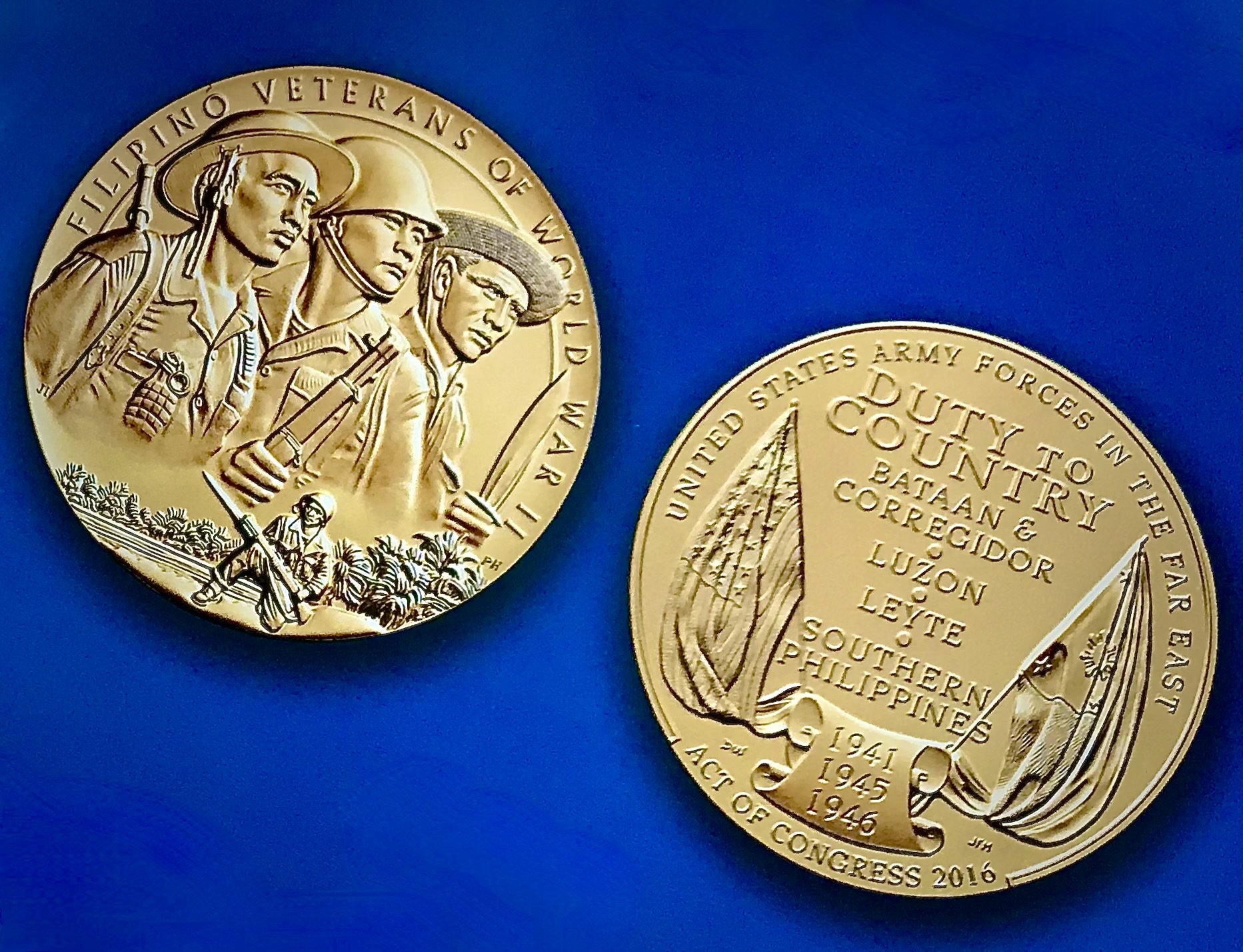
That same year, I accepted on my father's behalf the Congressional Gold Medal — our nation's highest civilian honor —awarded to Filipino Veterans of World War II.

 Its inscription reads:

Duty to Country — Bataan & Corregidor
Luzon • Leyte • Southern Philippines
1941–1945–1946
Filipino Veterans of World War II
U.S. Army Forces in the Far East
Act of Congress 2016

I had only known him as my father. 

In these pages he left behind, I met him as a witness to history.

Historical Note:

The Congressional Gold Medal is the highest civilian honor awarded by the United States Congress. In 2016, it was presented collectively to Filipino and Filipino American veterans of World War II in recognition of their service and sacrifice in defense of both the Philippines and the United States.

The medal, created by the U.S. Mint, features faces of these soldiers and guerrillas, representing a Filipino scout, a Filipino infantry regiment officer, and a guerrilla soldier in period uniforms, headgear, and weapons — honoring the more than 260 who served.  Over 57,000 estimated Filipino soldiers were killed, and thousands more were wounded or listed as missing.

The medal’s design honors the campaigns of Bataan and Corregidor, Luzon, Leyte, and the Southern Philippines, with the inscription “Duty to Country” alongside the years 1941, 1945, and 1946 — marking the invasion of the Philippines, its liberation, and the final chapter of wartime service.


THE GARDEN

Author’s Note

Just as adversity challenges us to discover hope, renewal, and beauty, memories and present actions encapsulate and embrace gratitude, connection, and a lingering sense of hope. 

When I approached writing this story, I wanted to capture the intimate human experience — that connection and bond between memory and place — physical space as a reflection of a person’s life, and the impact of moments filled with sensory details.

My father passed away over twenty years ago, but his memories still visit me from time to time. “The Garden” is a work of fiction inspired by my experience at a significant turning point in my grieving journey with my father’s passing.

This is a tribute to a father's love and the lasting impact on his daughter and family.

©2025 Myrna Urmanita. All Rights Reserved.

The Garden

Akira poked her head through an opening in the blanket, and bitterly cold air slapped her warm face. She quickly dropped back down into her soft pillow.

She felt Momo's wet nose nudging her feet.

 "Get up, Momo," she yawned. Momo ignored her, burrowing deeper under the sheets.

Another Saturday. Every Friday afternoon, Akira packed up Momo and drove to her Mom’s house, and every Saturday morning, they woke up in the same cold, stuffy guest room.

Before her father passed away, Akira promised to watch over her Mom. Her parents were together for over fifty years. Her father did everything for her mother—and Akira worried about how she’d manage.

Suddenly, Momo hurled off the bed and, with a thump, her short, stubby legs landed on the carpet. Akira jumped up, scooped her into her arms, and dashed down the hallway.

Hesitating at the sliding glass door, she glanced down at her bare feet.

"I forgot my slippers," Akira shrieked.

She stepped onto the icy concrete—sharp needles pricked her skin. A chill crept up her legs, freezing her in place. 

Excited, Momo wriggled free from her arms, scurried into the bushes, and vanished into the mist. Akira's father's garden was her playground. She loved exploring every corner, patrolling like a little guard dog.

The garden was Akira’s father’s sanctuary, too—a quiet space where he escaped. He had a gift for nurturing plants, pouring his heart into every tree, flower, and vegetable.  

His passion was rooted in his childhood back home in Japan, where he studied horticulture. A proud immigrant, determined that his family learn English, become citizens, and get an education. 

He retired as a county landscape architect. Diligent and resourceful, he upcycled materials long before it was trendy, building everything from scratch—from drip systems to greenhouses. 

As an art student, Akira remembered the wooden Pochade box her father had made for her. She rarely used it. It was a gesture of support, but it was too heavy for her to carry on her steep walks up to campus. It reminded her of his unwavering belief in her, even when it became a bitter reminder of her self-doubts, hesitations, and fears.

Remembering these moments, she spotted one of her father's work gloves on the ground. She picked it up, and a wave of sadness swept over her as she looked around. 

The garden, once vibrant, was sad and lifeless. She felt the loneliness creep in as she walked. The fruit trees, once proud and abundant, now leaned sadly, crippled by the relentless winds.

Akira ran to the garage, grabbed burlap sacks, and covered them as her father used to. Her fingers, numb and frozen from the cold, she struggled against their fragile limbs. 

“I miss him too,” Akira whispered.

She pushed down on the worn and splintered stakes, holding them up, and secured them as best she could. 

The earth was soaked with rainwater and filled her nostrils with a musky scent. As she stepped carefully, the sticky mud hugged her sinking feet. The mud squishing between her toes tickled, and it gripped tightly onto Akira's feet as she struggled with all her strength to lift her legs and pull free. 

"I feel like a kid again," she cried out, giggling, as she splashed her feet in the rain puddles.

Turning around the bend, Akira saw the bamboo trellises her father had built that once stretched toward the sky, now collapsed by the storm. The vines hung unsupported and defeated. She leaned and reached out to a lifeless vine, catching it as it dropped into her hand. 

“I’m so sorry. I wish he were here too,” she murmured, cradling it gently.

Near the concrete patio, she almost slipped on a puddle of water. The hose, twisted and lifeless, was spurting water from its ruptured underbelly. She carefully untangled it, and as she rolled it back onto its rack, a splash of cool water spurted from the nozzle and washed the dirt off her hands. 

Walking away, she turned to the hose and mouthed silently, “Thank you. I miss Dad too.”

Akira approached her father's tool shed; the stale, familiar scent transported her back to childhood. It was comforting, like a familiar blanket. Inside, she looked around in awe. The shed was a treasure chest, filled with gardening boots, tools, and her father's DIY handiwork — only he could understand.

Stepping outside, she took a deep breath and closed her eyes. She could hear Momo scampering on the gravel path.

That’s when it hit her—regret, gratitude, and clarity all at once. Akira never realized how much this garden had meant to her father—how much it had given him purpose, peace, and pride. He didn’t just plant things. He created.

“Dad’s gone,” she murmured shakily. The weight of that realization settled in her chest heavily.

But wherever she walked, whatever she touched—he was there. She felt his love, his energy, his joy tucked into every corner, every fruit tree, every vine, every mud hole, and every garden hose. This was no ordinary garden.

Just as she poured her heart into her art, her father poured his passion into his garden. This was her father’s masterpiece, his art gallery.

Feeling renewed, Akira lifted her face to the sun breaking through the clouds. She stretched her arms high toward the sky and waved her fingers into the light.

“Thank you, Dad, I get it!” she cried out excitedly.

Suddenly, Momo appeared, racing toward her. Surprised, Akira quickly bent down, scooping her through the air.

Momo barked as she twirled her high, paws outstretched to the sun. Akira laughed, breathless and free, and the garden answered—a chorus of leaves, wind, and memory—her father’s presence in every note.

Some things grow and begin quietly—patience shows what will bloom.

WISDOM HAS NO EXPIRATION DATE

Author’s Note

My next piece is not a story, but a reflection I felt deeply compelled to write.

Now that I’ve reached the age my parents were when they needed more help, I can’t help but admit how right they were about so many things they once tried to tell me.

“I get it. I understand.”
I find myself saying this often now—and I mean it.

When I look in the mirror, I sometimes see my mother’s face looking back at me. And with that reflection comes the realization of how much I once overlooked—about her, about my father, and about how often I stopped truly listening to them.

What goes around comes around. The cycle continues.

I no longer have to imagine how my parents may have felt—unseen, unheard, or quietly dismissed—despite the lives they lived, and the lessons they carried and tried to pass on. I know that as parents, we have all experienced those same feelings with our own children.

“Wisdom Has No Expiration Date” is not a complaint, but an invitation—to every generation—to pause, to listen, and to understand anyone, at any age, who comes forward to share a story, a thought, an idea, or simply a moment of connection.

It is about human connection—A reminder of our shared humanity—and a call to offer sensitivity, compassion, and kindness to one another.

©2025 Myrna Urmanita. All Rights Reserved.

Wisdom Has No Expiration Date

Having lived as long as I have, I belong to the older generation. We are the Baby Boomers, born 1946 - 1964. Our parents are the Greatest Generation, born 1901-1927, and the Silent Generation, born 1928 - 1945. 

We are the children who have lived through an extraordinary spectrum of personal, cultural, and historical changes. And yet, we are also the generations that have earned a quiet frustration: watching younger generations assume we have little or nothing to offer to the problems and issues facing the world today.

Never mind that we were the generations who carried responsibility, loss, reinvention, failure, recovery, love, and survival. We are the children whose parents lived through the Great Depression, fought in WWII, and some of us are the children of parents from the post-WWII baby boom.

We are the generations who lived through the Great Depression, World War II, the Cold War and Space Race, political turmoil and assassinations, the Civil Rights movement, the Women's Liberation movement, the gay rights movement, the environmental movement, the counterculture/hippie movement, the Vietnam War, Middle Eastern conflicts, the Persian Gulf War, and early post-9/11 operations, the rise of the Internet, and the digital revolution.

And still, our words are dismissed for carrying no weight or value. We become unseen in a world obsessed with speed, disposability, and a more-is-better mentality.

But, here is the hushed reality they are missing:

Technology changes. 

Language changes. 

Platforms change. 

Fear, ambition, grief, hope, ego, love, and resilience do not.

The only currency with lasting value is human connection. Leadership and success have always been about relationships—about building bonds grounded in sensitivity, compassion, kindness, and humanity.

We are the generations who do not need to shout or correct, but stand firmly in our lived reality. There is depth beneath our storytelling—depth that only time can create.

We are not seeking validation. This is about legacy. Our storytelling is not about ego or praise; it is about planting seeds. Seeds for those who will one day say, "Now I get it. I understand." 

And just as the cycle repeated itself with us, it will repeat with generations that follow.

We are not late, outdated, or irrelevant. We are the generations that have been there, done that, and are arriving now with power and authority that are not fabricated, but in real-time.

We don't just want to be heard.

We want to be felt. 

And feelings are what endure.

I am not alone in this. You are not alone. Together, we are not disappearing into the background.

We're leaving a light behind.

Some things that are learned are timeless — what comes next asks me to notice more.

NO IS NOT THE END

Author’s Note

One morning, while I sat enjoying a cup of tea, I read a social media post that disturbed me all day. This next story is a work of fiction inspired by that post.

That post implied that if a person says they are going to write a book, they must already be well-read, market-aware, and fluent in industry trends—otherwise, their work should not be taken seriously, trusted by professionals, or considered publishable.

On one hand, I agree that reading matters. However, creativity does not require a gatekeeper—as an artist, I truly believe this.

There are many paths to storytelling. Some follow well-worn roads. Others wander off the beaten path—and still have merit.

Artistic expression today often bends under commercial pressure. Writers who create from lived experience are frequently told they must conform to thrive. But art and writing are not born from market trends or industry approval. They are born from loss, reckoning, love, survival, and the need to make meaning.

Not all readers are concerned with competitive advantage or genre popularity. Some read because a story is emotionally honest—because it whispers something true to their hearts.

Artists create. Writers write. We do it with soul.

I write from my heart, driven by a desire to connect, so that my life experiences might touch and help others.

In this story, “No Is Not the End,” Yara, a writer, confronts the quiet harm of believing she needed permission to claim her voice.

©2025 Myrna Urmanita. All Rights Reserved.

No Is Not The End

“You want to be a writer? You’re going to starve.”

Yara sat at her desk, sniffling, as she typed those words into her laptop. They had haunted her for years, and she cringed with every letter she pressed into place.

She was seventeen when she told her father she wanted to be a writer. What should have been a moment of excitement—of possibility—became a memory that refused to loosen its grip.

“You want to be a writer? You’re going to starve,” her father had said, his voice low and certain.

The certainty was what stayed with her.

Now, decades later, Yara sat frozen at her desk, her stomach tight, her thoughts drifting backward—searching for the moment her life had quietly turned.

“Grandma, you got mail!” her granddaughter called from another room.

Yara pushed her chair back and made her way into the kitchen. A small stack of envelopes waited on the counter. Her granddaughter rushed past her, already halfway out the door.

“Bye, Grandma. See you later!”

Yara thumbed through the mail slowly, bracing herself. She wondered if there would be another rejection—another professionally worded dismissal.

She knew those letters well.

“We regret to inform you…”

Each time she read those words, they reopened the old wound, her father’s voice echoing beneath the polite language.

Yara had lived with the consequences of that moment at seventeen. She built a full working life—long commutes, two jobs, sleepless nights. She raised her children alone. Writing was something she carried quietly, like a secret she didn’t quite deserve.

There was never time.

Sometimes she wondered if her younger self had absorbed her father’s certainty too deeply.

Did I hinder my own potential? Did I sabotage small successes before they could grow? Was I afraid of success—so afraid that I chose failure instead?

She told herself she was an elder storyteller now. Someone whose stories belonged in kitchens, at sickbeds, with grandchildren, or shared quietly with strangers. Not on bookshelves. Not out loud.

Her father’s words had become a barrier—one she rarely questioned. She wanted to write, but she doubted herself. She believed she lacked the right background, the right training, the right permission.

She tried anyway.

She wrote stories shaped carefully to fit popular genres and market trends. She checked the boxes. She followed the rules. And each time, the stories came back to her with a rejection letter.

The industry seemed ready. Yara was not.

Then one day, the mail arrived again. This letter was different.

It wasn’t a form response. It wasn’t polished to distance. It simply said: “No — it’s not the end. It’s not yet.”

Yara read the words again. Then again. No one had ever said that to her about her writing. The sentence stayed with her, slowly washing away the old certainty she had carried for so long.

She returned to her desk and reread her stories—deeply pondering, evaluating, and processing.

"What’s missing? I love writing. So why don’t I feel it here?" she murmured honestly.

And then she understood.

She had been writing carefully, but not truthfully. Her stories were technically sound, but emotionally distant. They didn’t carry her love, her loss, her resilience. They didn’t carry her.

Years spent guarding herself against disappointment had hardened her voice. The absence showed on the page.

But when she told stories to her granddaughter—stories spun in kitchens, whispered at bedtime, shared with strangers—they were alive. They were filled with imagination, memory, grief, humor, and hope. They were born from her lived experience.

For the first time, Yara realized she already had everything she needed to write from her heart — not from necessity.

Now, when her granddaughter calls out, “Grandma, you got mail,” Yara no longer braces herself.

Her stomach doesn’t tighten.
She doesn’t trudge.
She trots.

She no longer hears her father’s words.

She hears instead: “No — it’s not the end. It’s not yet.”

The door is still open.

And where she once saw failure, Yara now sees something else entirely.

A work in progress.

Some words carry the weight of the future. Words tell the story—but the one who listens lives it.

TRUTH UNVEILED


Author’s Note

Have you ever asked a friend—or anyone—who they think you are?

Have you ever wondered how others see you?

Do you even know who you are?

A friend asked me that when I was going through cancer. During our conversation, we spoke about our purpose in life. That’s a question that visits you when your mortality feels close.

And in the last quarter of life, it comes up more often than you expect.

The only way I could answer it was to know who I am—what I love, what matters, what gives my life meaning. Without meaning, there is no purpose.

“Truth Unveiled” is my story.

My reflection of who I am.

My quiet truth.


©2025 Myrna Urmanita. All Rights Reserved.

Truth Unveiled

Having cancer changed my life. Everything that once mattered no longer did. My old life was stripped away, and I saw everything with a new perspective. Cancer woke me up from a deep sleep. It took me years to make it here, but it took a life-threatening diagnosis to become fully self-aware of who I am.

Being able to say, “I know myself,” is humbling and honest. It acknowledges my strengths, weaknesses, values, and boundaries — knowledge gained through reflection and lived experience.

Many people live their entire lives without ever truly knowing who they are. I have come to know myself, but not without fear, pain, and tears. Moving through them unveiled the truths that helped me better understand my character, feelings, motives, and desires.

Discovering that I am multipassionate and deeply empathetic is not something I became late in life. It is knowledge I finally felt safe enough to claim — to accept, and to have the courage to recognize. 

Looking back on childhood memories and early experiences revealed the roots of long-held patterns — my behaviors, beliefs, and values.

In my adult years, life didn't allow me to hear—there was too much noise— too many responsibilities, too much jumping through hoops, and proving my worth.

In retrospect, I approach life quietly.

I notice all its shades in slow motion. I see meanings others overlook. Life moves fast, and when it does, I feel overwhelmed — but when it finally slows, the entire landscape comes into view.

And this is where I am now — here, in this space. This is not merely an art and writing platform; it is a place of permission. For those who feel too much. For those tired of performing. For those who will one day face illness, loss, or sudden change and ask, “Who am I now?”

I know who I am. I am a survivor. I am self-aware. And I trust I will become what I am meant to be.

My truth has been shaped by confronting different perspectives of reality through reflection and the integration of life’s lessons. It comes from having lived, endured, loved, lost, listened, and learned. From that comes insight, discernment, and quiet wisdom.

But my journey is not over. I know who I am now — and I am still evolving. Tomorrow will bring another version of my imperfect self, and with it, a deeper layer of authentic truth.

When truth speaks, it comes from a place that is heartfelt, deeply personal, and genuine. It is exactly where the voice belongs — imperfect, purposeful, and honest.

My writing is my voice.

It speaks softly, not because it is uncertain. It speaks softly because it is confident enough not to shout.

And those who are ready will lean in to listen.

Some things reveal that I have arrived—I am not finished, and finally, I am willing to stay.

WELCOME HOME

Author’s Note

This story was inspired by my father’s final journey home. Though written as fiction, the emotions are real—love, longing, and the quiet ache of letting go. I wanted to capture more than grief. I wanted to show how memory can turn loss into light, and how even our goodbyes can carry tenderness and peace. Writing this story helped me revisit that moment not with sorrow, but with gratitude—for a father’s love that remains, even when the garden is still.

When I finished writing “Welcome Home,” I felt emptied—like the oil in my lamp had burned down to its last drop. I realized that every word had carried a piece of my heart, every memory a quiet tear. Writing can do that—it can both drain and heal.

I’ve learned that sometimes the truest stories come not from having the perfect words, but from allowing the silence afterward to speak. In that stillness, I felt something gentle: peace.

And maybe that’s where my father truly lives—not in the ache of loss, but in the light that remains when the story is done.

©2025 Myrna Urmanita. All Rights Reserved.

Welcome Home

A neighbor across the street waved. Kayla’s mother waved back as she sat sniffling in the rear seat. Kayla drove slowly, turning to follow the shiny black car in front of her onto the freeway.

“Are you okay, Mom?” Kayla’s sister asked, wiping the tears from her eyes.

Their mom nodded quietly.

The hum of the freeway pulled Kayla into her thoughts. Only a month earlier, her parents had been busy preparing for a trip to visit her aunt and her family out of town. Her mother was scurrying around the house, packing while her dad tended to his garden, preparing for his short absence. They would be gone only a few days, but his garden—his vegetables, fruit trees, flowers, and plants—was his baby.

“Don’t forget to lock the patio door,” Kayla’s mother shouted from the kitchen.
“I’m doing it now,” her father replied, irritated because he didn’t need reminding.

Kayla picked them up the following morning for the long drive. She drove her father’s car, leaving her car in their garage. It was about a four-hour journey from their home to her aunt’s place.

As she drove, Kayla tuned into the radio. Listening, she quietly prayed that her father’s doctor appointment would finally bring some light to his health issues.

“I can do all things through Christ who strengthens me—this is for Dad, God,” her lips silently prayed, digging deep into her faith.

Kayla’s father had been unwell for months—losing weight, suffering from headaches, struggling to eat. Every doctor he visited couldn’t provide a clear explanation or a diagnosis. Frustrated with the system, her aunt made an appointment with her own private physician.

The diagnosis: cancer. The prognosis is terminal, one to three months.

From the moment her father arrived at her aunt’s house, all he wished for was to return home. But that was not to be. Kayla’s father passed away exactly one month after his diagnosis, surrounded by family at her aunt’s home. He would never return to his beloved garden.

Kayla could still hear his voice as if it were yesterday—calling out from the patio, fussing over his plants.

“Don’t forget to water my orchids too,” her mother shouted.

“I know, I know. I’m watering everything,” he called back.
“I’m going to be gone for a short time, visiting my sister and her family,” he gently explained to his fruit trees, his vegetables, and all the plants in his garden.
“So, drink up, and I’ll be home soon,” he said softly.

After the funeral, Kayla followed the hearse that took her father back home to be buried at the cemetery near their house. She drove his car with her sister and mother accompanying her on the four-hour drive.

Kayla’s mother had asked the driver of the hearse to drive by their home first, so her husband could go home one last time. Her parents had been gone for over a month, and the house and garden sat empty and unattended.

“Oh, Dad’s car smells brand new,” Kayla blurted out in awe. He hardly drove it—only to church every Sunday.

She was getting the car ready for the long trip when she noticed the cassette tapes on the seat. She smiled, slid one into the player, and as the music filled the car, she was instantly transported to another time—when her father sat beside her, white-knuckled, teaching her to drive.

“I’m sorry, Dad, I’m trying. Stop yelling at me!” Kayla cried, nervously turning the wheel.
What bittersweet memories, she thought. Her father constantly berated her during every driving lesson. He had zero patience and a fierce temper.

Of course, she failed the driving test! It was inevitable. She was so nervous—all she could think about was failing and her father yelling at her for doing so.

Kayla laughed as she sat listening to the cassette tape, remembering how she failed the test because she didn’t know how to do a turnabout. Her perfect father—her driving teacher—forgot to teach her how to complete one! It became their family joke, her excuse to blame him for her failure at the DMV.

Still, beneath all those memories of his short temper was love—the kind that showed up as pancakes in the morning and her freshly washed and well-tuned car in the driveway.

“I’m not going to see Dad again,” Kayla whispered to herself. His anger, his smile, his laughter—all gone. She would never again eat his breakfasts, his special recipes, or his freshly baked rolls.

“Hi, Kayla, where are the kids?” her father asked, peering behind her as she unloaded the luggage from her car.

“They’re there, Dad. They’re in your garden running around,” she replied, breathing a sigh of relief as she set the bags down.

“I made pancakes and bacon,” her father happily announced, handing each kid a slice of bacon.
“Don’t touch the fruits on the trees, and don’t trample my vegetables,” he gently reminded them.
“Okay, Grandpa. Can we have more bacon, please?” they sheepishly asked.

Whenever Kayla visited, her father was always waiting and ready to greet her and the kids, smiling, hugging, and cooking. He would wash her car in the driveway, check the oil, air up the tires, and replace the windshield wipers.

The laughter faded as rain began to tap on the windshield.
“It’s starting to rain. Turn on the windshield wipers, Kayla. I can barely see,” coaxed her sister.

Kayla turned on the wipers. Her eyes filled with tears, and she quickly wiped them away with her fingers, trying not to let her sister or mother notice. Following the hearse in this rain was agonizing. The traffic slowed to a crawl; horns blared, drivers yelled, and music pierced through the rain-drenched windows.

Kayla turned up the music to drown out the chaos, and a song began playing—one that reminded her of her dad dancing. He loved to dance.

She smiled as she pictured her parents at the club, moving in perfect rhythm. She chuckled, remembering one evening when her father grabbed her hand to dance. As she tried to pull free, her mother grabbed his other hand and joined in. That was a complete surprise because her mother never danced—at least, the kids never saw her dance before. But there she was, dancing up a storm with her father, both of them laughing with friends, having the time of their lives.

“What’s so funny?” her sister asked.
“Dad and Mom dancing,” Kayla explained with a soft laugh.
“Huh?” her sister replied, confused.
“I can dance,” Kayla’s mom chimed in, smiling smugly. The sisters broke into laughter, grateful to hear their mother’s voice light again.

The traffic began to move, and Kayla glanced at her sister. Relief washed over them as the cars picked up speed, giving them some distance from the hearse.

“Are we almost there, dear?” her mother asked softly, resting a hand on her shoulder.

“Almost there, Mom. I’m turning onto the exit soon,” Kayla replied, signaling to pass the hearse and guide the way to the house.

As the road opened up, the scenery changed. Everything was greener, with trees and shrubs lining the coastline. The rain finally stopped. Kayla rolled down the window and breathed in the ocean air. It was clean and fresh, the sky bright and blue. It reminded her of being at home, standing in her father’s garden.

Dad cherished their house, especially his garden. It was his sanctuary—his pride and joy. Every plant he nurtured seemed to hold a bit of his spirit: patient, steady, and full of care. The garden was his way of saying I’m here, I love you, even when words failed him.

Kayla’s eyes filled again. Thoughts of her father never again harvesting his fruits or tending his plants—tinkering in his shed, building stuff in his garage, putting up the outdoor Christmas lights, washing his car—made her heart ache. He would never enjoy another holiday or birthday, cook another breakfast, or play with his grandchildren. His friends and neighbors would no longer share in the bountiful gifts of his garden.

As they entered her parents’ neighborhood, the energy in the car shifted. Kayla’s mother began to cry, and soon her sister joined her, sniffling as they turned onto their street. The hearse pulled up in front of the house and stopped.

Kayla parked behind it, her tears blurring her view. Her sister, quietly sobbing, also peered through her window. Kayla’s mom made the sign of the cross and waved goodbye. She bowed her head, wept softly, and pressed her face into her tissue.

“Dad, you’re home,” Kayla muttered, her voice trembling.

She sat quietly behind the wheel, hands resting in her lap. Through the blur of tears, she saw him—walking up the path, making his way through her mom’s maze of potted hydrangeas. He paused, turned his head, and with that familiar smile, he waved. Then, as softly as the wind, he disappeared into the house.

“Welcome home, Dad,” Kayla whispered.

Some things only reveal themselves when we pause—and look back.