One day, while sorting through my father’s papers—letters, keepsakes, fragments of a life—I found a large manila envelope filled with handwritten and typed manuscripts. Tucked between them was a plain white business envelope. Inside were several sheets of lined paper, neatly folded.
I unfolded what I thought was a letter. It was a manuscript. The title read: “World War II: Defenders of Bataan and Corregidor."
I showed it to my mother. She told me my father had written it years ago for a journalist working on a story about Filipino prisoners of war—the survivors of the Bataan Death March in the Philippines, carried out by the Imperial Japanese Army.
I sat down on the sofa and began to read.
Tears came quickly, blurring the page. I sank deeper into the cushions, overcome by a numbness I couldn’t name. What I felt was confusion—sharp and disorienting. A sense of incompleteness. A missed opportunity. I was reshaping my father’s image in real time, even as I found myself grieving him all over again.
As children, we know our parents only in the roles they play for us: protector, provider, authority, comfort. We rarely see them as individuals with inner lives of their own—with dreams, abilities, fears, talents. When something surfaces that reframes them as complex strangers, the ground can shift beneath us.
Our parents were once simply people—unique, unfinished, living full lives long before we knew them.
It’s okay to let them rest.
It’s okay to walk our own paths and move forward.
It’s okay to carry only what strengthens us.
The story that follows is my father’s story.
The voice he left behind.
The following is my father’s original manuscript, written in his own words and preserved exactly as he left it. (I made minor mechanical corrections for readability)
-World War II- Defenders of Bataan and Corregidor
By Reynold Urmanita
A Survivor of the 194th Tank Battalion
We are the defenders of Bataan and Corregidor — short of food, supplies, and ammunition. No pills, no planes, no artillery pieces, and no reinforcements that we had expected but never came, and nobody gave a damn.
They marched to their deaths by the thousands, but their sacrifice was not in vain. For the battling bastards of Bataan — half-starving, sick, and tired — the earthquake at 4:00 p.m. on March 9, 1942, must have been the last straw.
Since Good Friday, April 3, 1942, 11,000 Americans and 66,000 Filipino troops commanded by General King had been retreating south through the jungles, swamps, and mountains of the Bataan Peninsula in western Luzon in the Philippines. They were under mounting pressure from some 150,000 troops of the Japanese Imperial 14th Army commanded by Lt. General Masaharu Homma.
The battling bastards of Bataan were overwhelmingly outnumbered and outrun. They were heavily pounded days and nights with 150 artillery guns bombarding them with more than 60 tons of aerial bombs. They were strafed by swarms of Zero fighters. The Japanese were the uncontested rulers of the skies, having destroyed the U.S. armada of B-17 and P-40 planes neatly lined up at Clark Air Force Base and Iba Airfield, which were being fueled and armed while crews and pilots enjoyed their lunch eight hours after the surprise attack on Pearl Harbor in Hawaii.
Those who died as a result of what must have been America’s worst military defeat — as said earlier — their sacrifice was not in vain. At a dreadful price, the battling bastards of Bataan stopped the overwhelming Japanese Imperial Army war machine for five months. The effort was crucial time — long enough for American industry and military forces to fortify Australia and block the Japanese invasion of the continent. It was an invasion that almost would have succeeded if General Homma could have enjoyed the easy victory his superiors in Tokyo had expected.
Those Americans and Filipino troops of Bataan and Corregidor, with the time they bought at the price of their lives in a hopeless battle, prevented a catastrophic scenario.
The troops who fought under Generals King, Wainwright, and MacArthur quite possibly saved millions and millions of lives — many American, Filipino, and also Japanese. This great achievement of our gallant soldiers happened partly because Generals King and Wainwright, with their hungry and tired battling bastards, continued to hold the line until May 6, 1942.
Bataan’s 11,000 Americans and 66,000 Filipino troops, short of food and ammunition, were ordered to surrender by their commander, General Edward King. Four weeks later, the island fortress of Corregidor in Manila Bay, commanded by General Jonathan Wainwright and held by 15,000 troops, fell to the Japanese Imperial Army.
American and Filipino troops who did not surrender and were not taken prisoners of war went on to fight as guerrillas in the Philippine jungles for the next three years. Those who obeyed the order to surrender — estimated at 70,000 — many of them sick, weak, and starving, were forced to march 65 miles under scorching heat of 90 degrees to prison camps. Only 54,000 lived to reach them. An estimated 10,000 died on the way, and others escaped to the jungles. In 1946, the commander of the death march was convicted by a U.S. military commission and executed.
Among those taken prisoner of war were members of the Salinas-based 194th Tank Company of the California National Guard, who were shipped to the Philippines in the fall of 1941 on what was supposed to be a five-month tour. Of the 167 men, only 47 came home.
Now these survivors may walk with little spring in their steps, and their ranks are getting thinner, but let us never forget that when these men were younger, they saved the world.
Today we celebrate the anniversary of the fall of Bataan and Corregidor. Yes, there are very few of us here today. It is human proof of America’s resources. Our own people answered the call. We did our duty and came home. No welcome parades, no parties.
We recovered from our wounds of war and built new lives. Some gave up months and years of home life they would have enjoyed. Some gave up sweethearts, wives, husbands, parents, and children. Some received Dear John letters. Many gave their lives unquestioningly. All gave up willingly.
Wounds will heal. Pain will cease. But what we fought, died, and suffered for will live forever, as long as those who come after us share the devotion.
General Douglas MacArthur once said:
“No finer fighting unit ever was so organized or fought so bravely. I do not know the dignity of their birth, but I do know the glory of their death. They died unquestioningly with faith in their hearts and hope on their lips that we would go on to victory.”
Author’s Note
This manuscript was discovered among my father’s personal papers years after his passing. I had never known he had written about his wartime experience. He was one of the survivors of the Bataan Death March — one of only 47 men from the 167-member Salinas-based 194th Tank Company who returned home.
In 1987, these men were honored with the Bronze Star during a World War II Remembrance Ceremony at Salinas City Hall, marking the 43rd anniversary of the Allied invasion of Leyte.
In 2017, I was contacted to provide documents about my father’s military service, including his transition from the Filipino Army to the United States Army Forces in the Far East (USAFFE).
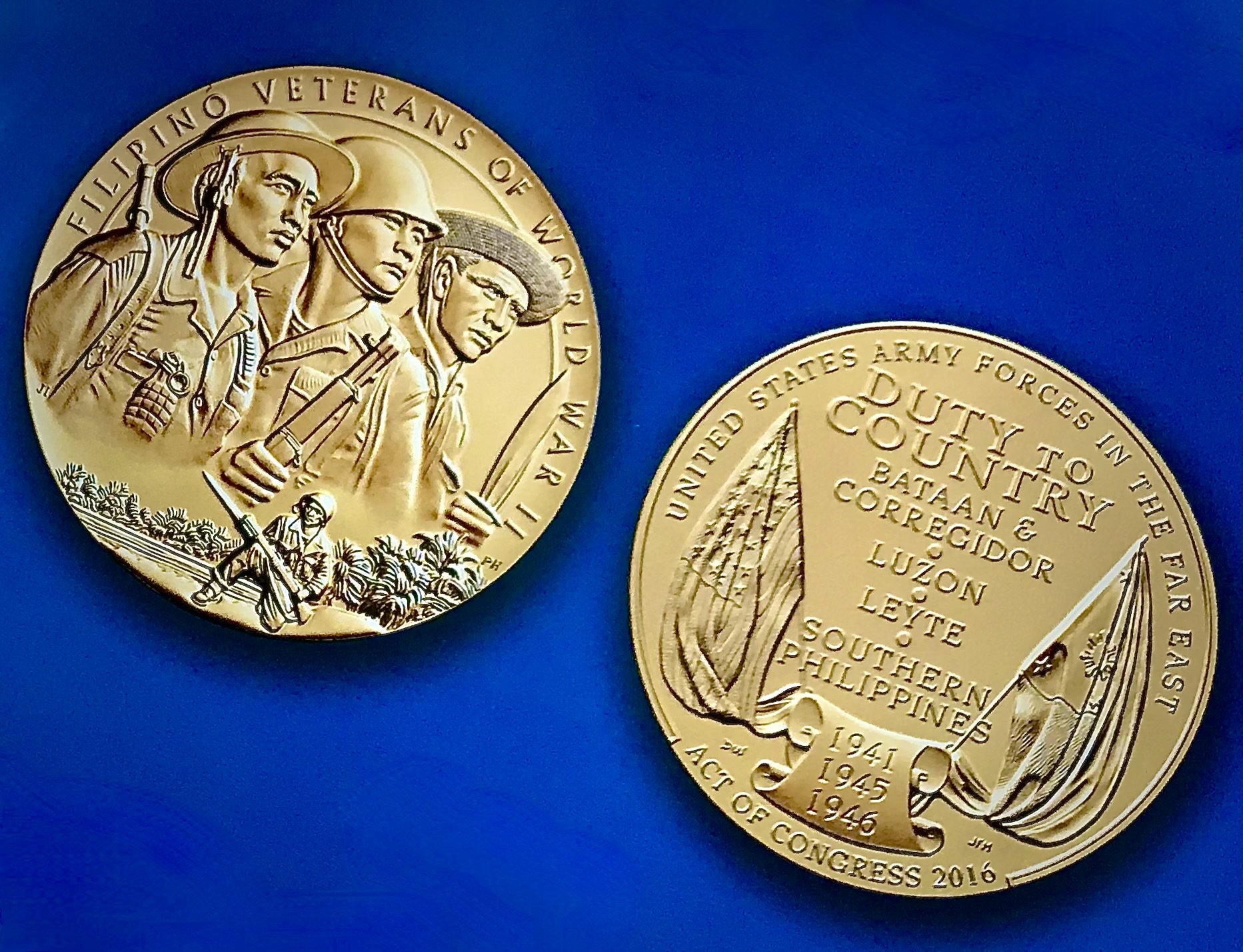
That same year, I accepted on my father's behalf the Congressional Gold Medal — our nation's highest civilian honor —awarded to Filipino Veterans of World War II.
Its inscription reads:
Duty to Country — Bataan & Corregidor
Luzon • Leyte • Southern Philippines
1941–1945–1946
Filipino Veterans of World War II
U.S. Army Forces in the Far East
Act of Congress 2016
I had only known him as my father.
In these pages he left behind, I met him as a witness to history.
Historical Note:
The Congressional Gold Medal is the highest civilian honor awarded by the United States Congress. In 2016, it was presented collectively to Filipino and Filipino American veterans of World War II in recognition of their service and sacrifice in defense of both the Philippines and the United States.
The medal, created by the U.S. Mint, features faces of these soldiers and guerrillas, representing a Filipino scout, a Filipino infantry regiment officer, and a guerrilla soldier in period uniforms, headgear, and weapons — honoring the more than 260 who served. Over 57,000 estimated Filipino soldiers were killed, and thousands more were wounded or listed as missing.
The medal’s design honors the campaigns of Bataan and Corregidor, Luzon, Leyte, and the Southern Philippines, with the inscription “Duty to Country” alongside the years 1941, 1945, and 1946 — marking the invasion of the Philippines, its liberation, and the final chapter of wartime service.