©2025 Myrna Urmanita. All Rights Reserved.
When The Music Takes You Back
The other day, when I sat down to work on my novel, a wave of nostalgia stopped me mid-thought. I paused, opened my Apple playlist, and went searching — searching for an artist I hadn't heard in decades, one who had captured the very essence of my college years in the late 60s and early 70s.
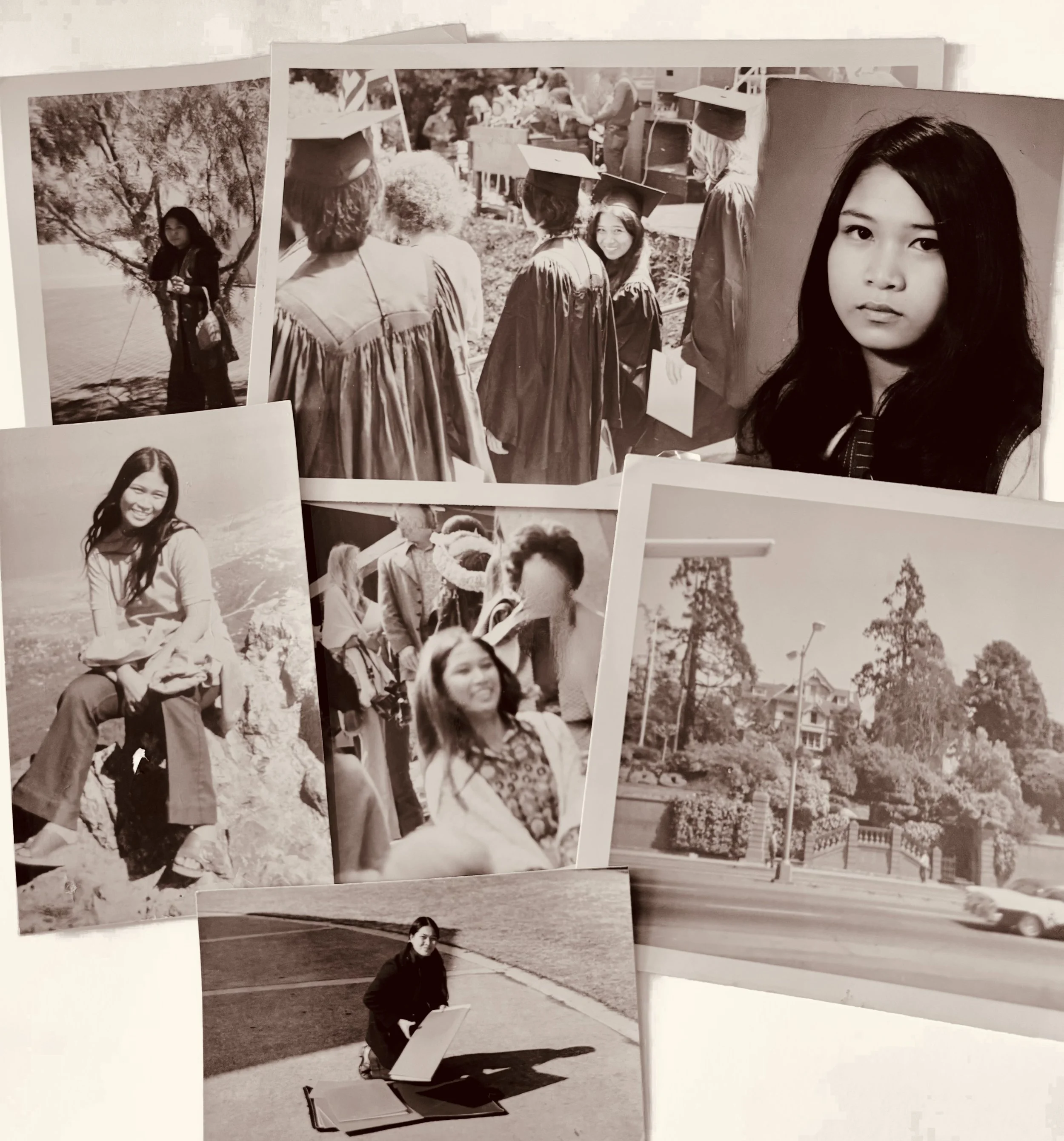
I was a flower child of the 70s — not a hippie, but an artist. That distinction mattered. After graduating from high school in 1967 and junior college in 1969, I left Monterey when I just turned 20, and transferred to a private art school tucked into Oakland's Rockridge neighborhood: the California College of Arts and Crafts, now called California College of the Arts.
The campus had an unorthodox, rebellious, non-conformist approach to art—breaking traditional rules. It welcomed creative artists who embraced experimental and anti-establishment art forms, the face sweeping the broader Bay Area arts scene then.
The college was very close to the University of Berkeley. Then, a radical school in the early 70s —the heart of the counterculture movement, anti-war demonstrations, and the beginnings of the establishment of ethnic studies programs.
It was a period when both campuses were caught up in the intensity of the political and cultural turbulence — the Free Speech Movement, anti-Vietnam War protests, and the home of the Black Panther movement. CCAC's proximity meant we shared the same rebellious socio-political ecosystem as UC Berkeley.
And yet, the artist in me was drawn to something quieter.
Much of the folk and rock music captured cultural tensions and contrasts—introspective, urban, or politically charged. But I, like many students navigating that turbulence, found myself drawn to John Denver. His music didn't carry angry protest words. Instead, he offered soft, moving melodies, advocating nature, peace, and humanitarian causes. He bridged the musical landscape with a unified "feel-good" and easy-listening sound that was heartwarming and nature-centric, at a time when everything around us felt like it was on fire.
In my novel—Once Upon A Red-Tiled Roof— I've centered one of John Denver's songs as an involuntary trigger for my protagonist. It's the moment that carries her back into her past, linked indirectly to her deepest emotional memories. My approach to writing is cinematic. I weave words into a tapestry that lets the reader slip inside a scene and experience it alongside the character—her world, her history, her feelings.
It's not a love story. Not a survivor story. It's about giving oneself permission to live.
I discovered something unexpected while writing it. One day, I played John Denver's song while I worked. The song in my novel — the song that triggers my protagonist. When I heard it, I drifted back — and I was 20 again. Back at CCAC. Back on campus, living my student life.
And then something shifted.
My protagonist’s song became my dopamine. My adrenaline. The key that unlocked the flow.
My fingers moved briskly across the keyboard. My eyes stayed fixed on the screen. Around me, a deafening silence. I was no longer inventing details — my brain was running on all cylinders, my characters breathing on their own, telling me where the story needed to go. Time vanished completely.
I had entered the zone.🌺
—
“Music does a lot of things for a lot of people. It’s transporting, for sure. It can take you right back, years back, to the very moment certain things happened in your life. It’s uplifting, it’s encouraging, it’s strengthening.”🌺
—The late, great singer Aretha Franklin—